
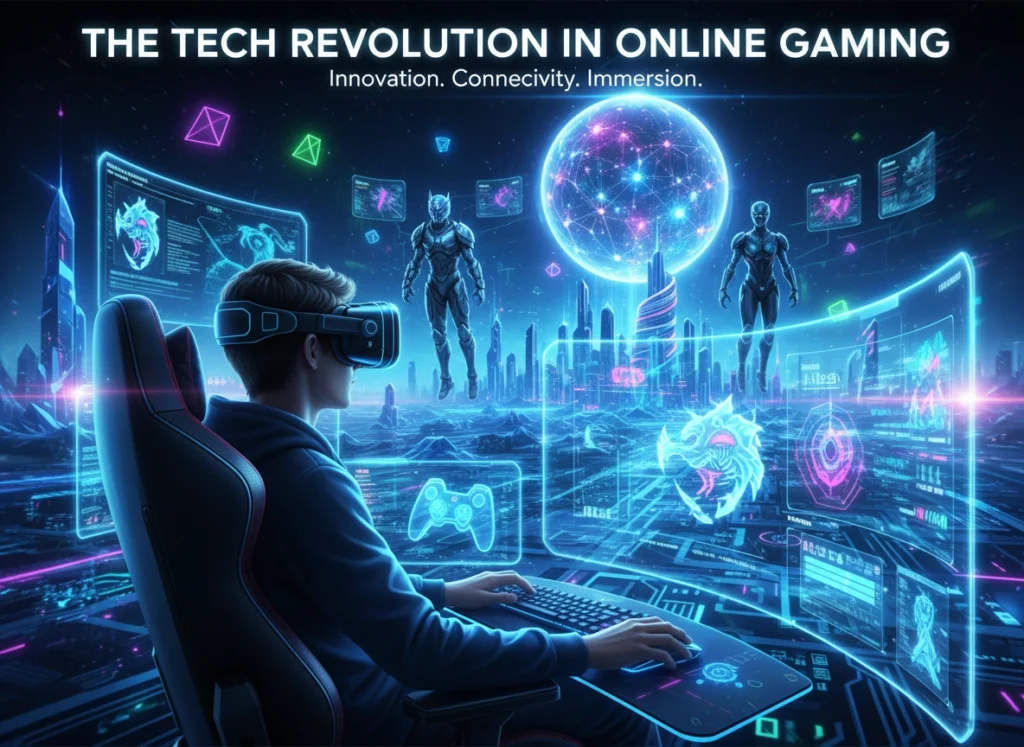

The online gaming industry has transformed from a niche hobby into a global entertainment powerhouse. This evolution wasn’t accidental; it was driven by relentless technological innovation. From pixelated sprites to photorealistic worlds, technology has fundamentally altered how we play, compete, and connect through games. These advancements have not only enhanced graphics and gameplay but have also redefined accessibility, community building, and the very economics of the industry.
This article explores the profound impact of technology on online gaming. We will examine how key advancements have shaped the current landscape and look ahead at emerging technologies like AI, VR, and blockchain that are set to write the next chapter of interactive entertainment.
From Dial-Up Dungeons to Digital Worlds
The journey of online gaming mirrors the progress of consumer technology. Early multiplayer experiences were limited by slow dial-up connections and basic hardware. Games like Ultima Online and EverQuest were revolutionary for their time, creating persistent online worlds where thousands of players could interact. However, they were often plagued by lag and required significant commitment.
The widespread adoption of broadband internet was the first major catalyst. Faster, more stable connections eliminated lag and enabled more complex game mechanics. This new foundation allowed for the rise of Massively Multiplayer Online Role-Playing Games (MMORPGs) like World of Warcraft, which brought millions of players together in a shared, seamless universe. Suddenly, coordinating a 40-person raid was not just possible, but a mainstream activity.
Simultaneously, advancements in hardware, particularly graphics processing units (GPUs), empowered developers to create visually stunning environments. The leap from 2D sprites to intricate 3D models and expansive landscapes made virtual worlds more immersive than ever before. This visual fidelity, combined with reliable connectivity, set the stage for the modern era of online gaming.
The Pillars of Modern Online Gaming
Several key technologies have defined the current state of the online gaming industry, making it more accessible, connected, and dynamic.
Cloud Computing and Game Streaming
Cloud infrastructure has been a game-changer. It provides the backbone for hosting massive game worlds, processing player data, and delivering content updates efficiently. More recently, cloud gaming services like Xbox Cloud Gaming and NVIDIA GeForce NOW have shifted the paradigm entirely.
These platforms stream games directly to a player’s device, much like a movie on Netflix. This eliminates the need for expensive, high-end PCs or consoles. You can play graphically intensive titles like Cyberpunk 2077 on a smartphone or an old laptop, as all the heavy processing happens on a remote server. This technology drastically lowers the barrier to entry, making high-fidelity gaming accessible to a much broader audience.
The Rise of Mobile Gaming
The smartphone in your pocket is a powerful gaming console. Mobile technology, from powerful processors to high-resolution touchscreens and 5G connectivity, has spawned a colossal market. Games like PUBG Mobile, Genshin Impact, and Clash of Clans boast hundreds of millions of players and generate billions in revenue.
Mobile gaming’s success lies in its convenience. It allows for short, engaging play sessions anytime, anywhere. This accessibility has introduced gaming to demographics that might never have purchased a dedicated console, making the player base larger and more diverse than ever.
New Models of Monetization
Technology has also revolutionized how games are sold. The traditional model of a one-time purchase has been supplemented, and in many cases replaced, by new monetization strategies.
- Free-to-Play (F2P): Games like Fortnite and Apex Legends are free to download and play. They generate revenue through optional in-game purchases for cosmetic items, such as character skins and weapon designs. This model removes the initial cost barrier, attracting a massive player base.
- Games as a Service (GaaS): Many online games are now treated as ongoing services. Developers provide a steady stream of new content, including events, updates, and expansions, to keep players engaged over months or even years. This is often supported by battle passes or subscription models, creating a continuous revenue stream.
The Next Frontier: Emerging Technologies
The pace of innovation is not slowing down. Several emerging technologies are poised to redefine the online gaming experience once again.
Artificial Intelligence (AI)
AI is already used in gaming for creating smarter, more challenging non-player characters (NPCs). However, its future role is far more expansive. Generative AI can be used to create dynamic, ever-changing game worlds, quests, and narratives that respond uniquely to each player’s actions. Imagine an NPC that remembers your past conversations and develops a personalized relationship with you. AI can also improve matchmaking systems, pairing players of similar skill levels more accurately, and enhance anti-cheat systems to ensure fair play.
Virtual and Augmented Reality (VR/AR)
VR and AR promise the ultimate level of immersion. VR headsets transport players directly into the game world, offering an unparalleled sense of presence. Games like Half-Life: Alyx have demonstrated the incredible potential of VR for single-player narrative experiences, and multiplayer platforms like VRChat are creating new forms of social interaction.
AR, on the other hand, overlays digital information onto the real world. Pokémon GO gave us a glimpse of its potential, turning parks and landmarks into virtual playgrounds. Future AR games could transform our living rooms into battlegrounds or our cities into fantasy realms, seamlessly blending the digital and physical.
Blockchain and Web3 Gaming
Blockchain technology introduces the concept of true digital ownership. In traditional games, the items you buy or earn exist only within the game’s walled garden. With blockchain, these items can be represented as non-fungible tokens (NFTs) that you truly own. You could potentially sell them on open marketplaces or even use them across different games.
This “play-to-earn” model, seen in games like Axie Infinity, allows players to earn real-world value from their time spent in-game. While still in its early stages and facing challenges related to sustainability and user experience, blockchain has the potential to decentralize game economies and empower players in unprecedented ways.
Challenges and Opportunities Ahead
This technological wave brings both challenges and immense opportunities. The cost of developing cutting-edge games continues to rise, potentially squeezing out smaller, independent studios. Furthermore, issues of data privacy, online toxicity, and the ethical implications of AI and play-to-earn models need to be carefully navigated.
However, the opportunities are even greater. Technology is making gaming more inclusive, immersive, and socially connected. It is enabling new creative possibilities for developers and new ways for players to engage with their favorite hobby. The lines between gamer and creator are blurring, and virtual economies are becoming increasingly integrated with our own.
The impact of technology on online gaming has been nothing short of revolutionary. It has turned a simple pastime into a complex and dynamic ecosystem that sits at the forefront of digital entertainment. As we look to the future, one thing is certain: the game is just getting started.
Please visit website for more info.